


Activism
“Chervivy Minsk” is a chthonic herald of Belarusian “actuality” created by Tony Lashden. It is the kind of newspaper we hope to one day see on the shelves of “Belsayuzdruk” (the state-run Belarusian press kiosks — Ed.). Editor’s Choice! Read our conversation with Tony about the essence of this journal and the journey of its publication.
— Tell us, how did the idea to create the newspaper “Chervivy Minsk” come about? Was it a long-term plan or a sudden realization of a need for a new type of media for Belarusians?
— This newspaper emerged during my participation in the “Mycelium” decolonial laboratory, organized in 2024–2025 by Belarusian researcher and curator Antonina Stebur. Within the lab, we discussed the processes happening in modern Belarus from various angles—and those that have shaped its historical perspective. The central question that occupied us was the applicability of colonization/decolonization discourse to Belarus. Is there something for it to decolonize from, and what is happening to it now? Is it colonization, neocolonization, or something else entirely?
This deep immersion—we met over the course of a year—helped me formulate my own research interests within this theme. Since I am a media researcher by education, I decided to look at how the state press in Belarus serves the penetration of Russian interests into the country’s economy and necropolitics, smoothing over the rough edges. For example, if Belarus is not officially participating in any war, where do the dead Belarusians fighting in Ukraine on Russia’s side come from?
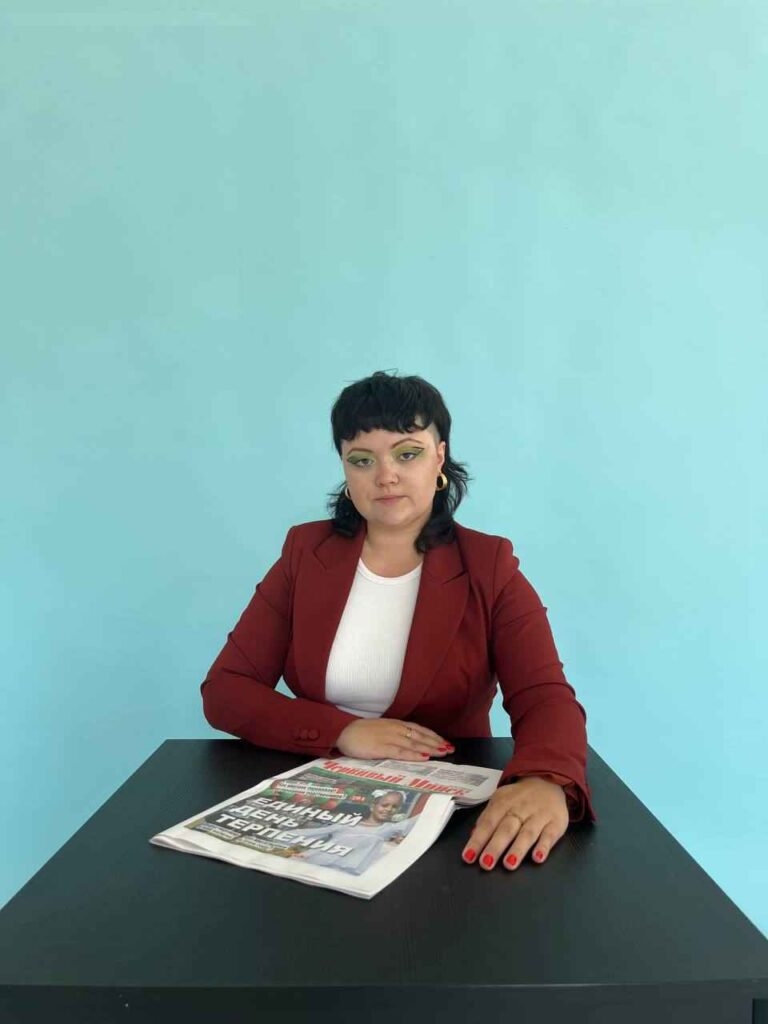
— The name “Chervivy Minsk”—where did it come from? What do you put into the word “chervivy” (wormy/heart-suit): is it a reference to Belarus’s “communist” past, or more of a nod to Lynchian neon lights?
— “Chervivy Minsk” is a chthonic city herald, a mirror twin of the newspaper “Vecherniy Minsk” (Evening Minsk), which is familiar to every resident of the capital because it’s exactly what they read in the metro, city cafes, and at factories. For me, “worminess” is about the lacunae, holes, and burrows where life actually happens. Implicit and secret, this life is hidden under a layer of earth that one must break through to see and understand what is actually going on.
— What is the editorial policy of the newspaper? What will a reader definitely find on the pages of “Chervivy Minsk”—which themes and columns?
— The newspaper writes about daily life, city heroes, and the cultural, political, and economic life of the capital. “Chervivy Minsk” is oriented toward a wide audience. It is a paper you can read starting from any page, at any minute of any day. Everyone will find something for themselves: horoscopes, TV listings, gardening tips, the latest production news, and interviews with key people shaping the city’s life.
In addition, I allowed myself to experiment with form within the newspaper format. Inside, there are standard fiction texts, a play, an interview, cross-genre inserts, manuals, folk spells (zamovy), and jokes I invented myself. This opportunity to step beyond the boundaries of traditional prose helped me highlight certain topics that I think would have remained in the shadows in classical fiction.
— Where did you draw your internal boundary: “this we write, but that we don’t”? Were there themes, taboos, or approaches that you fundamentally avoid, believing the Belarusian reader is definitely not ready for?
— I think the Belarusian reader has already seen and lived through so much that they are ready for anything. My fundamental writer’s position is that a text should not mindlessly re-traumatize; it should not relish in lawlessness and violence just to show that I *can* write about lawlessness and violence. Besides, I feel enough books have already been published on that, and I see no need to add more to that topic. Therefore, if the newspaper tells of violence, it is always with the intent that this violence does not remain meaningless.
Since this is a satirical newspaper, satire always implies a sting. I tried to write the texts so it was clear: this sting is aimed at power structures, not at the people who are coping with the pressure of these structures under very difficult conditions. My heart is always on the side of the Belarusian people.
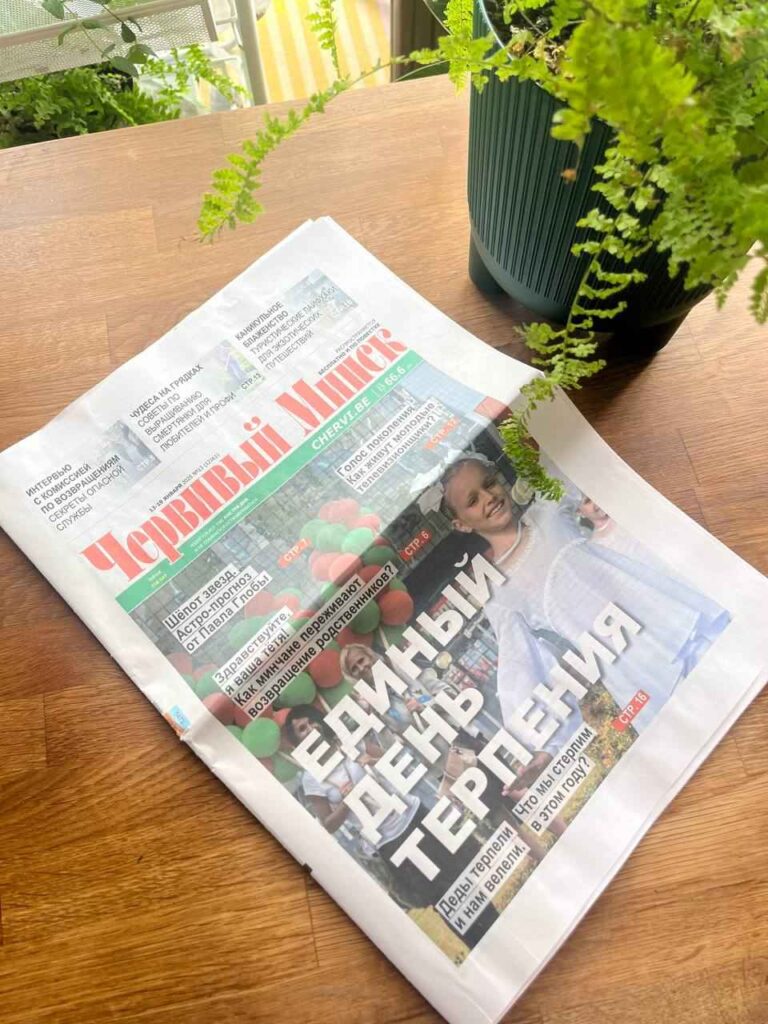
— We are familiar with book publishing, but not newspaper production—how difficult was the path from idea to print? How did the layout, mock-up preparation, and search for a print shop go—what was most unexpected?
— To release the newspaper, I gathered a team that helped me refine the texts and embody the idea in a physical artifact.
In preparing the layout, my comrade and “designer right and left hand” was the Belarusian designer Alina Odren. Alina is a brilliant professional, and I was infinitely happy she was interested in the project. Together, we came up with how the paper should look, and Alina realized that vision. She suggested several visual solutions and “Easter eggs” that tied the newspaper’s content together.
Additionally, my dear colleague Vlada Khmel helped with error-catching and proofreading, and another colleague, Daria Gerasimenko, helped me devise a summer media campaign to promote the paper. Besides them, I had an anonymous supporter who helped me with the printing when I was about to give up.
Printing was the hardest part of the whole process. Since I wanted the newspaper to exactly replicate the original—the same texture, the same smell, the same look—I had to find a place that would print it. I contacted 25 print centers specializing in newspapers and received 25 rejections. Some refused because of the small print run I needed (usually runs start at 1,000), some due to the lack of a legal entity, and others because of the content. This project had no funding—I did everything at my own expense. Printing 1,000 copies was unaffordable for me. Where would I store them? What would I do with them? At one point, I was in despair. I am very grateful to those who helped me in this process.
Eventually, quite by chance, the person helping me found a place in Belgium that was ready to print it in the quantity and quality I required.
— Do you plan to make “Chervivy Minsk” a regular publication, or is it more of a one-time gesture, an experiment that works precisely because of its exclusivity?
— Initially, I decided to make a newspaper rather than, say, write a book, because the process of book publishing, in my personal experience, is infinitely long. Two years can pass from the moment a manuscript is finished until the book is in print. I had the illusion that a newspaper would be faster. But experience showed that by the time I figured it out, made the layout, and found a print center—a year had passed.
For me, the newspaper was a one-time experiment with form, an attempt to show that literature doesn’t have to react to life “here and now” only retrospectively and with a significant delay—it can do something more. The next project will likely be a book again.
— How accessible is the newspaper? Can citizens of Belarus get access to the first run, and how can it be purchased?
— The newspaper exists as both a physical and an electronic copy. You can buy it here.
Furthermore, people from Belarus can simply send me a direct message on Instagram and buy the digital paper for Belarusian rubles (you can also obtain the newspaper by writing to our email – Ed.).

— Do you see a future for the newspaper in other formats—online, digital issues, paid newsletters? Or is it fundamentally important for you that “Chervivy Minsk” exists as a physical, material object—a paper you can touch, unfold, accidentally leave on a kitchen table, or wrap something in?
— Yes, the materiality of the newspaper was almost the paramount issue for me! I really wanted the paper to exist as a visual trap. You glance at it and think, “Oh! It’s the newspaper ‘Vecherniy Minsk’.” You pick it up to read, perhaps out of nostalgia, you start flipping through, and you realize something is wrong. I’ve observed several times in places where this paper was distributed how people first laughed, then began reading closely—and then froze over the paper.
I want to talk about complex topics related to Belarus, about existing political and economic dependencies, and about future scenarios. But I understand the exhaustion of the Belarusian people—both inside the country and in emigration—with these topics. That is why, recognizing that the old tools of public engagement are not working, I am looking for new forms to maintain a conversation about Belarus and create precedents for discussing its fate without tears, fist-shaking, or complaints about fortune.
I sincerely hope that people will wrap dried fish in my newspaper, stuff it into winter shoes to keep their shape, push it into window frames for insulation, and make paper hats out of it if they need to paint their walls.