


Psychology
Emigration is not just a change of scenery, but a radical dismantling of the persona. When familiar pillars collapse and the background noise in one’s head becomes louder than the sounds of a foreign city, the search for “normalcy” turns into a survival quest. For some, this path leads through a psychiatrist’s office; for others, through late-night calls to questionable acquaintances. But what if the line between a “patient” and a “junkie” is merely a matter of marketing and a successful prescription?
The heroine of our interview traveled the path from displacement in a foreign country and street amphetamines to mindful microdosing with legal methylphenidate. This is not a story about getting high, but about the right to “simply exist.” It’s about how stimulants transform from a drive into a framework for a crumbling psyche, and why the social abyss between the pharmacy and the street is the greatest mystification of our time.
High as Normalcy? “As if nothing prevents me from simply being”
— Hi! When did you first try amphetamine? How did it happen, and what pushed you toward that decision?
— I tried amphetamine for the first time in emigration. It was a guy from my social circle. I had zero interest in amphetamine; I was never really drawn to it. We started talking a lot and hung out for a bit. One day, a friend of his came over—he had been waiting for this friend anxiously; they had served time together for weed. The friend lives normally now, well even, and doesn’t seem to use anything. My acquaintance was so excited and told me: “I want to get high with him.”
I hadn’t tried speeds at that point. My opinion of amphetamine came from former acquaintances who said it was complete trash. This came from people who smoked weed constantly, used psychedelics or empathogens: Molly, ecstasy, all that. But about speeds, I heard exclusively that it was a nightmare. The vibe was—better not to start at all because terrible things happen to you and people in general when you use them.
At the time, I was only using LSD on a regular basis, and I was fine with that; nothing else interested me. But emigration changes things. I was constantly disoriented and thought, why not? Perhaps the person who visited made a good impression—he looked “normal,” and I thought, “okay.”
— What was your first impression?
— I didn’t understand what was happening at all because I didn’t feel the effect of amphetamine the way I did with, say, Molly or ecstasy—those change me drastically. But I didn’t feel that then. I was in a situation with a new experience, new people who weren’t close to me, feeling lost and confused… I didn’t feel relaxed or in my place. But when I took a line, I don’t know, the only thoughts that visited me were something like: “What’s happening? Why do I just feel normal?”
At that point, I was either on or coming off yet another antidepressant. When you’re prescribed new pills, you discuss with the doctor what you’d like to change and what state you want to achieve. Medication trials didn’t even come close. It wasn’t the same experience as antidepressants. From them, I felt an effect, that I was changing, but I didn’t feel great—I just felt different.
But here, it was like a crystal-clear state; the feeling formulated as being a “normal person.” Perhaps for the first time in my life, I felt okay. If on LSD I felt amazing because I felt like a part of everything on a molecular level, on “vitamin” [slang for amphetamine] I just felt okay. As if nothing prevented me from simply being. No thoughts that suppressed me or created discomfort. The endless permanent process that usually happens in my head—and sometimes doesn’t even let me breathe normally because I’m oversaturated with a million processes—just stopped. Everything just let me go. I could just be, see people, and talk to them.
— How would you describe the “amphetamine episode” of your life during that period? Was it chaos or, on the contrary, an ideal order that is missing in sobriety?
— Actually, I had no chaos. Rather, it was bewilderment because I had heard so many stories about how people behave, how their jaws start clenching. I didn’t feel any caricaturish behavior: no weird movements, I didn’t start feeling like a different person. On the contrary, it was the opposite of chaos.
I remember thinking then: what is actually going on? Either I remembered about ADHD, something I heard once, or I Googled it. Somehow the info resurfaced that for people with ADHD, amphetamine works differently. That stimulants simply level them out because they are constantly overstimulated on their own. They exist in a state that can be confused with bipolar: when you have too much energy, you’re on stimuli, doing one thing, then another, then a third, and then you crash because you can’t survive in that mode. A stimulant gives you the ability to choose and act in a way that is more understandable to yourself.
— Many fear the “comedowns,” but for some, it’s a time for reflection. What were those hours for you when the effect wore off?
— In fact, this was one of the moments that grew my feeling that amphetamine was my substance. My life was hard, and I even lamented in my own way that I couldn’t find solace in booze or drugs. That I hadn’t become a drunk or a junkie yet simply because I couldn’t do it. All the substances I tried before… well, you can’t get hooked on LSD, though it was my substance too. With everything else, I wasn’t super high; my reflection wouldn’t let me go. I knew I couldn’t get hooked on them even if I wanted to. It would be like holding my nose and forcing it into myself on purpose.
And amphetamine, on one hand, set me free, but on the other—it scared me. I realized there is a drug you can actually get hooked on. Under “vitamin,” I felt simply normal. And I understood I had no reason not to use it. The only thing that scared me was how it affected the body: washing out calcium and so on.
As for the comedowns: as I said, it was a moment of growth for the feeling that this was my substance because I had no problems with it at all. I liked the comedowns as much as the highs. If before I was sharp, concentrated, “dense,” and gathered, as the comedown progressed, I just started feeling more fragile—more delicate, more sensitive, but still gathered. The mental nagging didn’t return. It was also a clean state, just more sensory. And I liked that too, because usually when I feel fragile, it means I’m screwed. You know, when you spend two weeks preparing to go to the store, and a light breeze hurts your whole body. Here, it wasn’t like that. I could exist even through this fragility.

— Was it always like that? Did you never feel side effects from use?
— Mostly not. Harsh comedowns appeared when using with someone else not according to your own schedule: using their lines and their intervals. Well, then the comedowns are heavier. When I used alone, I could feel and distribute it: I knew how much more I needed or where to make a longer pause. But with others—everyone has their own norms. That’s when the comedowns are more aggressive and sharp.
Or when you mix with booze. And you inevitably start mixing: if you’re drinking and feel yourself getting “muddy”—you take a line and continue the fun. It’s like the ancient Greeks: they feast, go vomit, and continue feasting. Hedonism, damn it.
And with booze, it was rough: there were moments when I lay for three to five hours just listening to music under warm light. And if I had to get up to do something, I moved very slowly… In short, a state in which it’s impossible to live; you just have to wait. And I realized that this was bullshit. That I shouldn’t mix it with booze.
— At what point did you realize it was time to stop? How much speed were you going through a week?
— I don’t remember exactly how much now. Despite finding compatibility with the substance, before I started buying it myself, I read a lot and tried to bug people about their experiences. I read about amphetamine addiction because I knew: I’m going to buy in bulk now, it’s cheaper, and I’m going to get hooked, bitch. And I wanted to know what I was getting into.
— How many times a week did you use? Just on weekends or did it bleed into weekdays?
— No, I only went hard on weekends if I was with someone. Otherwise—every day.
— Every day? For how long?
— At least two months for sure.
— How did you come to the conclusion that you needed to quit?
— That moment never actually came—where I realized the substance was hindering me or something. It didn’t happen. On the contrary, I understood: “Yes, I’m okay living on speed.” These were microdoses, not in the format of “2 grams a night and then you’re down.” For me, I just started feeling the lines: how much I needed in the moment, a bit more or a bit less. Compared to people who blast 2 grams a night, it really was microdosing.
Few know that amphetamine was originally sold as a decongestant. In the 1930s, the company Smith, Kline & French released the “Benzedrine” inhaler, which could be bought without a prescription. People quickly discovered the side effect of an energy boost, and students, drivers, and even housewives began taking apart the inhalers to eat the drug-soaked strips inside.
A recent study published in the journal Cell (December 2025) overturned the understanding of how stimulants work for ADHD. Scientists from the University of Washington conducted thousands of brain scans and found that drugs like Adderall (amphetamines) do not work through attention centers, as previously thought. In fact, they activate alertness and reward zones. Simply put, they don’t “fix” focus directly; they mimic the effect of a good night’s sleep and make a task more “interesting” (valuable) to the brain. This explains why people with ADHD feel “normal” and well-rested on them, even if they were in total chaos before.
Coming Off the High Swings: “Speed sends you somewhere itself, but the medication simply helps you move where you want to go.”
— When someone decides to quit the “system,” the speed, what is the hardest part?
— I can’t speak for everyone, but for me, it turned out to be a state in which I just felt comfortable living. Because I have a lot of discomforts, and those states where everything overwhelms me—it’s like pain, sometimes physical, from contact with the outside world or certain people. You can’t hide from it. But using the way I did every day, you can support yourself.
Even when I stopped using every day, for at least another six months I always had speed with me; it comforted me. I knew for sure if I was going to a meeting, I’d take a line, or I’d even use before and during to avoid drowning in the difficulties of communicating with a person. Because I start getting that overstimulation, and then I need a long time to recover. So for me, the difficulty of coming off speed is that I’d have to return to that state where living mainly means feeling disoriented, lost, and pained.
— Did you try to find a legal substitute for amphetamine, to switch to “pharmacy speed”?
— Yes, it worked. I got lucky. But I went there (for a legal amphetamine analogue) because I just wanted to keep being high. It helped that when I moved to Warsaw, I stayed in touch with a psychiatrist from Belarus. At one point, when another antidepressant didn’t fit, she said: “Your psyche is stronger than antidepressants; it just adapts.” I said: “Okay, is there anything else?” And I trusted her—I confessed that I tried amphetamine. I described my experience, and she told me about ADHD. That in Poland, firstly, diagnosis is likely better, and secondly, unlike Belarus, there is the possibility to prescribe the necessary medicine with similar effects.
I went to a psychiatrist. After another failed experience with antidepressants—where the drug felt like it was just crudely messing with my brain and nervous system—he prescribed what I needed. I went to the doctor and said: “Look, the latest antidepressant is crap.” And I told him: “Last time I worked with a psychiatrist in Belarus and the antidepressant failed again, she said I should try ADHD medications. Since Poland has them and Belarus doesn’t.”
After warning me that such drugs could cause dependency, he prescribed me methylphenidate.
— Legal medications—they don’t quite reach the level of amphetamine. They don’t have that pronounced “stim.” How do you deal with the feeling of not getting enough “drive”?
— Even though I now have a drug that replaces amphetamine for me, I’m still on a very low dose. I stretch it out too. I take it at intervals when the effect starts to wear off. Because I take a drug that acts immediately and ends quickly. It has zero cumulative effect. I take these small doses, say, two or three times a day—each time before the effect starts to drop. To maintain that state. I prolong myself.
But when I tried a bit more and just started feeling that effect, it triggered me hard toward amphetamine. I realized I just couldn’t stop myself from snorting a line. But this small dose of mine, whose effect I sometimes don’t even feel as an “effect”—it’s what stops me from taking amphetamine and lets me stay in a normal state.
And that’s exactly what helps me not to use drugs. And to realize that I have a different path now. In Poland, as I understand it, only one substance is available—methylphenidate. In other countries, there are variations really similar to amphetamine, right with a “rush.”
— If there are such drugs that are indistinguishable from amphetamine, what is the difference between street amphetamine and pharmacy medication?
— It’s about chemistry: dopamine and norepinephrine are the two main players. Amphetamine performs a powerful release of these neurotransmitters, and then you have a compensation—the “comedown.” But methylphenidate doesn’t release anything. It performs reuptake inhibition. Like antidepressants. If even a little bit is released, it just doesn’t let it disappear immediately. With ADHD, the problem is this: you get impulsively fired up, but forget it on the way. This drug helps hold the impulse and focus. It gives stability.
With amphetamine, I like both the high and the comedown, but you’re on damn high swings. I once saw such swings on a tall structure with a huge amplitude—that’s amphetamine. But my medication is the playground swings: back and forth. If you sit at home under a blanket, you feel weird on it without a task, but you can sit still. But when you’re doing something, walking, talking—then everything is great. You blast speed and it sends you somewhere itself, but this drug simply helps you move where you want to go.
Few know that methylphenidate (Ritalin) was named after Rita, the wife of chemist Leandro Panizzon, who synthesized the substance in 1944. Rita suffered from low blood pressure and often felt lethargic. She took her husband’s drug before playing tennis, claiming it helped her focus on the ball and gave her strength for the game.
In the 1950s, doctors seriously discussed using this substance to treat “boredom” and “social apathy,” not realizing then that they had found the gold standard for treating ADHD.
A new study from a consortium of European neuroscientists showed that long-term use of methylphenidate in therapeutic doses for ADHD doesn’t just “replace” dopamine, but helps restore the structural integrity of the brain’s white matter. Researchers found that in patients who switched from street stimulants to pharmacy control, neuron myelination improves over time, making their psyche less “fragile” in the face of external stimuli (that same overstimulation).
Utopia for Junkies and Medics: “The street can give a lot to the pharmacy, and the pharmacy to the street”
— What is the main profit for you in a legal life on “pharmacy meds”? Safety, peace of mind?
— It distances me from the mood swings, from the swings, from vivid states. And what distances me from vivid states also distances me from suicide. I am a very suicidal person. Right now, I’m on these “rails”: I want to distance myself from suicide. And that’s damn hard, because it’s always with me.
You know, when I really get on those swings, I never know how it’ll end. Because last time I went into suicide through harmony. Well, in short, for me, it stopped being something that comes only in decline. Now it can come through, on the contrary, some kind of ecstasy. Like, I understand it’s so good right now that I want to stay in it—and that’s it. And there’s nothing you can do about it.
So—choosing this path. I even think it’s not so much about the drug itself as about my attitude toward it, how I perceive it. To me, it’s like the English words embrace and dedicate. There are no such precise translations in Russian. That is, it’s not just “making a choice,” but if you’ve already made it, then you’re already making it, you’re already existing through it.
It’s not like: “Well, I’ll be with this girl, but I’ll be looking around all the time—maybe there’s someone better, maybe I should hook up with someone else.” Well, in short, if you’re already with this person—that’s it. You say: “Yes, there are cool people, but right now I’m directed at this person, I want to build a relationship with them, that’s my priority.”
Right now I’ve made such a choice and I’m in it. For me, it’s about the word embrace. And the word dedicate—it’s like to dedicate yourself to something. Like “devote,” but without that Christian spiritual connotation. Simply as a focus: you took it on and you’re doing it.
For me now, it’s like that. I just don’t think about anything else… Right now it has pushed aside all those amphetamine-suicidal movements. Again, I don’t know how it would be if I weren’t in emigration, if I hadn’t been so twisted here—because it really is a total disaster.
I am now at the stage of feeling for some kind of balance. Some kind of state in which I can simply not die constantly, not live this dead inside. I chose small steps because big thoughts start to wreck me. I’m trying, you know, to win small victories. That is, right now I chose this medication and I’ll move this way. Later—we’ll see.
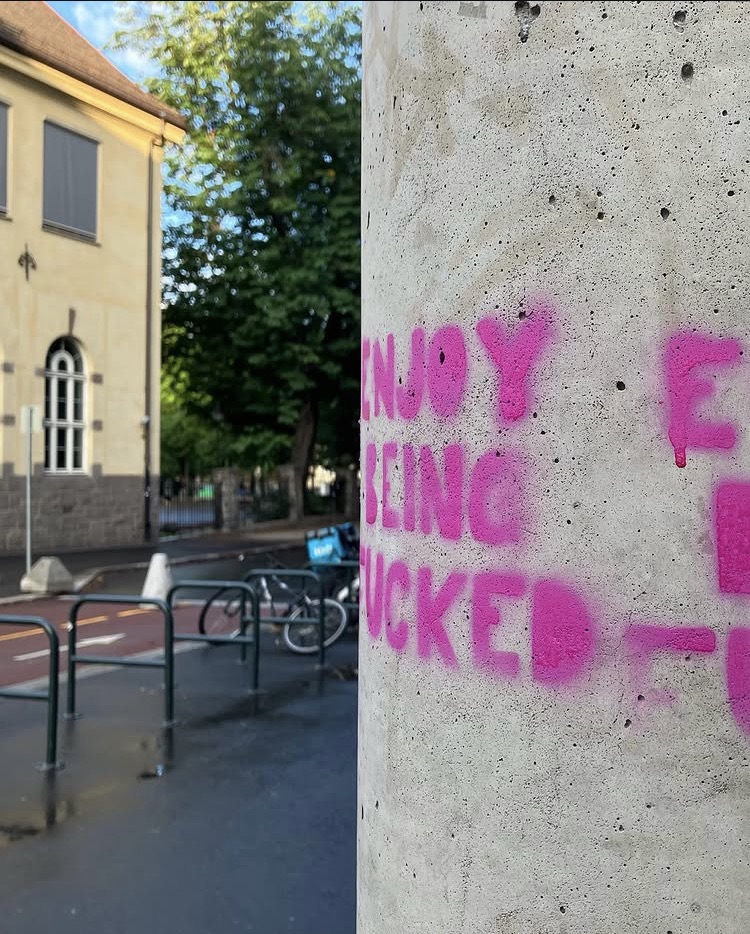
— Can legal drugs displace drugs from the streets? Do you think if antidepressants have become an integral part of our lives, an amphetamine analogue can take the same place?
— Pharmacy and street move absolutely in parallel. Essentially, if you cut the corners a bit, every street drug has its analogue in the pharmacy. People just choose a path, that’s all. They can be absolutely identical: those who smoke weed and those who are on antidepressants. They might have the same spiritual constitution. But if you meet them on the street, you’ll realize these people will never cross paths. They look different, live differently, they don’t associate with each other at all: “This person is absolutely not from my circle.”
And I see a problem in this—in the social layers around drugs and around medications. Depending on where you hung out and what narratives you got used to, you develop a certain attitude. And if you grew up “on the street” and you’re in drugs, then going to a psychiatrist and switching to legal meds is a serious step. It means you’ll likely lose your circle. Because there is this damn abyss, created absolutely artificially. Though it’s the same thing. Same crap, different name.
And the problem is that some get high while others take antidepressants that, say, cause erectile dysfunction, though they could smoke weed and have sex for pleasure. But due to cultural mess-up, they can’t. Someone will snort amphetamine and wake up in a sweat but scream: “Pharmacy—never!” Both suffer simply because cultural-social garbage explains to us that these are different things.
The problem is in the artificially created social abyss and the rigid division into “drugs” and “medications.” The solution is probably utopian in the scale of this universe, but it’s the same for all questions: I think all this should be abolished. The street can give a lot to the pharmacy, and the pharmacy to the street. If they stop being in conflict, a gradient can be created: someone needs a little weed, someone—medicated methylphenidate. We could negotiate. Doctors and junkies. Junkies actually know their stuff: about doses and states. If these people united and exchanged info—that would be cool. Today, it’s only possible within individual heads. In this damn universe, people see more value in contrast: “I’m awesome because I’m not such trash as him,”—even if they themselves aren’t doing so well in all of it.
Chemical Cousins with Different Fates: In the 1950s, methylphenidate (the future “Ritalin”) was considered a “mild” stimulant that doctors prescribed even to treat lethargy after barbiturate use. The most ironic thing is that for a long time, methylphenidate and amphetamine (under the brand “Benzedrine”) legally competed on adjacent pharmacy shelves. The split into “dangerous drug” and “useful medicine” happened not for chemical reasons, but because of marketing: the manufacturers of methylphenidate intentionally positioned their product as a tool for “functional citizens” who just need to level out their condition, not look for a high. This laid the foundation for the very social division you call an “artificial abyss.”
A group of sociologists and neuroscientists from the University of Oslo published data from long-term monitoring in countries that implemented elements of “decriminalization through medicine.” It turned out that in communities where the rigid line between “addict” and “patient” is blurred, mortality rates from overdoses drop by 40%.
Scientists proved that it is exactly the social “contrast” that prevents people from seeking help in time. An addicted person’s brain perceives a trip to the psychiatrist not as treatment, but as a “betrayal of identity.” The study results confirm your thesis: combining the experience of the “street” (understanding states) and the “pharmacy” (dosage safety) is the only path to real harm reduction.