


Emigration
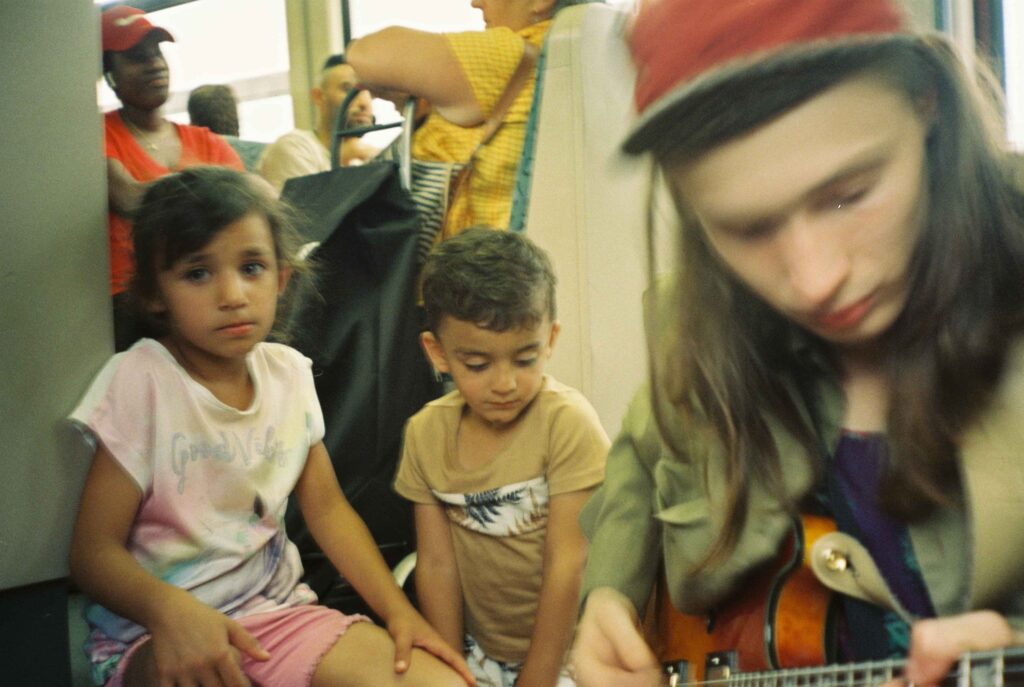
Chemix is an immigrant from Ukraine living in Berlin. Here, he earns a living as a street musician, favoring psychedelic sounds and improvisation over covers and playlists, and the noise of the S-Bahn over clubs and stages. Nottoday spoke with Chemix about his sound, Berlin, and street music—and in the process, Chemix shared the music he listens to.
On Sound and Music
— Do you remember when you first realized that music could be psychedelic?
— Yes, I think initially, before I became a teenager, I didn’t really acknowledge Pink Floyd and so on. I thought they were just “mushy” and all that. But then my grandfather’s brother showed me Pink Floyd, and I was like: “Interesting atmospheric sound.”
And then I listened to The Doors, Morrison’s lyrics, translated all of it—and I was like: “Yeah, this is deep, of course, these flows are something else.”
— Are you saying that the music you play is a continuation of 60s and 70s psychedelic rock, a reference to that time?
— One way or another, yes, the roots are there. But sound doesn’t stand still. You can look at it that way, but I think it’s already completely different music.
At the very least, they played mostly on analog instruments, whereas now virtually all sound is digital. That’s the difference: before, the sound was warm and tube-driven, and now it’s fragmented and digital.
— How would you describe your sound to someone who has never tried anything stronger than coffee?
— I think it’s something between the drive of metal and techno and the feeling when you’re just buzzing from a good mood. At the same time, it has a certain poetic quality, an emphasis on what’s happening. It’s as if you’re very, very aware of the current moment, that’s all.
— What is more important to you—technique or the trance in music?
— Serious question. Probably technique, because without it, you can keep yourself in some kind of trance, but the cool thing about music is that it’s a collective thing. So, yes, maybe trance is more important after all. At the same time, if you don’t have the technique, you won’t be able to show what’s in your soul either. But perhaps the soul is more important. If you just play music for the sake of technique without an idea—like in metal, for example—there are many groups like that. Everything is very technical, played great, produced great, but there is no trance component. Trance is more important.
— Do you use the noise of the city as part of your music? You play on the street?
— Yes, I’d like to include it in my tracks—this S-Bahn noise. I think it’s just essential, a very important part of the Berlin sound. You listen to other DJs, and they also insert various Berlin sounds. When you play on the street and an ambulance passes by—you can play something along with it so that people feel it too.
If something scary is happening, or the cops are driving by—you can play something more punk.
I think the noise component in music is very important. Noise has been used for 50 years now—it’s a vital part.
— What is Berlin’s characteristic noise?
— I think the noise of Berlin is the howl of the trains, the sound of the S-Bahn, that door beeping, the sound of a train pulling away. There’s also a cool train here that plays “do-re-mi-fa-sol-la-si” when it starts. So yes, I think it’s the sound of the trains.
— Often in psychedelic rock, loopers and delay are used—repeating elements. Why those specifically? How do they affect a person’s perception of music?
— Going back to the question of what’s more important in music—trance or technique. By using all these delays, you get a pattern that resembles itself but changes slightly. All techno is built on delay. Filters change, different frequencies sound, while one note repeats. One sound can be processed in very different ways.
On the City
— Why specifically the street, rather than stages or a club?
— Is that a trick question? I would like to move into clubs, but I feel like the street really teaches you how to interact with people. If your music hooks people, they actually stop. Those who love this kind of sound, the depth in music—those people stop and listen.
If you’ve learned to hook such people on the street, then on stage your sound will be even more interesting, because you know how to not just interact with a crowd, but how to work with the collective unconscious.
— What do you feel when someone walks past and doesn’t stop?
— I don’t know, I don’t really look at passersby, very rarely. I’m usually in the zone of playing. When I do look around, I look more at the people who are standing and watching, and I try to maintain some non-verbal connection with them. There’s no point in looking at those who aren’t interested.
— How do locals or tourists react to your music? Who shows more responsiveness?
— At first, when I arrived in Berlin, I thought the target audience was tourists. Before that, I had traveled around Europe playing street music and thought they were the best audience. But after arriving in Berlin, at some point, I got bored with what I was playing. I used to play a lot of covers, and eventually, I got tired of it.
I realized that tourists only respond to what they already know—pop culture. If you play something poppy, it hooks them, but not the kind of people it’s interesting to talk to.
Over time, I realized that the coolest audience in Berlin is the ravers. If you hook the ravers, it’s really cool: you feel the response, and more energy appears in the music.
— Which places in Berlin do you consider truly alive, where you feel that the music breathes with the city, where it turns into something unified?
— I think Warschauer Straße and Friedrichstraße, but those are quite “poppy” places. Lately, I like playing near clubs—it’s interesting. You feel what fits people coming out of clubs: it’s like an afterparty—a guy standing on the street playing music. It’s an interesting moment.
The most alive, touching moments during street playing happen at night, in places you would never have thought of.
— Berlin is currently called a “mechanical paradise.” Do you feel freedom in it or, on the contrary, a cold system?
— This cold system is felt, of course. But Berlin is not Germany. It is not that cold machine that Germany is, in principle. Berlin is something else. You feel it here too, but the city is so free, man! There’s so much room for creativity. If you have the initiative to realize something—this is probably the best place to do it.

On Meanings and Psychedelia
— What is psychedelia to you—sound, consciousness, a form of protest, or just aesthetics?
— Probably an expanded state of consciousness. Of course, aesthetics too, but overall—expanded consciousness emerging from the moment.
A kind of synesthesia: when all the senses call out to each other and a unified visual-audio-scented picture is created.
I think that is what psychedelia is.
— Do your states, dreams, or memories influence the music you create?
— Yes, definitely. Like any artist: you feel something—you’re like a sponge that absorbs. Or like camera film: you absorb feelings, then transform them through yourself. That is the task of the artist—to turn received feelings into a product.
— Do you have a personal experience that changed your perception of sound or time?
— Yes, the moment I stopped playing other people’s music and started giving myself over completely. Sometimes I caught strange states when you play all night, then return very tired but in a state of bliss. Your eyes are already closing, and any sound you hear echoes. This echo responds with a psychedelic guitar—multi-repeating. Any sound is multiplied by the guitar. A very interesting state.
— What do you think about the connection between street music and altered states of consciousness?
— If you’re too messed up, you won’t be able to play. But one way or another, you need some kind of fuel. You can play sober, but you won’t last long—it’ll just get boring.
A beer, a joint—a vital component, I believe.
— If music could speak about itself, what would it say to the world right now?
— That we need to unite and not get hung up on all kinds of nonsense. I suffer from this myself, but I think humanity just needs to unite, think less about bullshit, enjoy life, and do what makes you happy.