


Emigration
At one point, we already reviewed a part of the independent music scene in Belarus, whose participants partially moved to Georgia and continued to pursue their passion there. In this piece, we invite you to read an interview with the Telegram channel “Padpolny Vesnik” (The Underground Bulletin), which is also dedicated to music.
“Padpolny Vesnik” writes about the local Belarusian music scene, the latest concerts, and news. What is happening with the music scene in Belarus, why are there so few gigs in the cities, and what new releases are worth listening to — read about it in this new material from “Not Today, Not Yesterday, Not Tomorrow.”
“Podpolny Vestnik”
— Recently, after well-known events, many Belarusians have left. What happened to the independent music scene? What is its current situation?
— The independent scene continues to function. Organizing concerts has become a more difficult task than before—the amount of bureaucracy and the number of approvals required to hold an event is constantly increasing. Sometimes, sudden changes in conditions lead to a total absence of evening events in the city for a couple of months.
The number of bands has decreased significantly, especially in the hardcore and punk environment. At the same time, many completely new names have appeared—remaining musicians from the previous wave are teaming up with younger kids in new projects.
The club situation is unstable. For example, throughout 2023, there was only one club in Minsk suitable for gigs—Growling Bar. This year, venues like Reactor and Brugge have returned, and they are still battling waves of legislative changes to this day.

— The Belarusian independent scene has had many ups and downs, such as the rise of punk rock and hardcore in the 2000s and techno in the 2010s. What is happening in 2024?
— It feels like the most in-demand genres among young people are guitar indie, shoegaze, and midwest emo. However, the old-timers also attract significant interest—just look at the Challenger Deep concert and their return this year.
— How is the revival of the scene going? Many clubs and venues have ceased to exist. Where and how do gigs take place now?
— As I mentioned, Reactor and Brugge—cult places for the underground scene—came back to life this year. Reactor focuses on touring acts, while Brugge alternates them with local concerts. However, as recently as the beginning of this year, there were no options for concerts—only underground activities at rehearsal spots were taking place.
— How often do gigs happen, and how many people come to relax and listen to music?
— The number of gigs depends on the general legislative situation. For example, this summer it wasn’t possible to hold a single event, excluding raves and a countryside open-air festival.
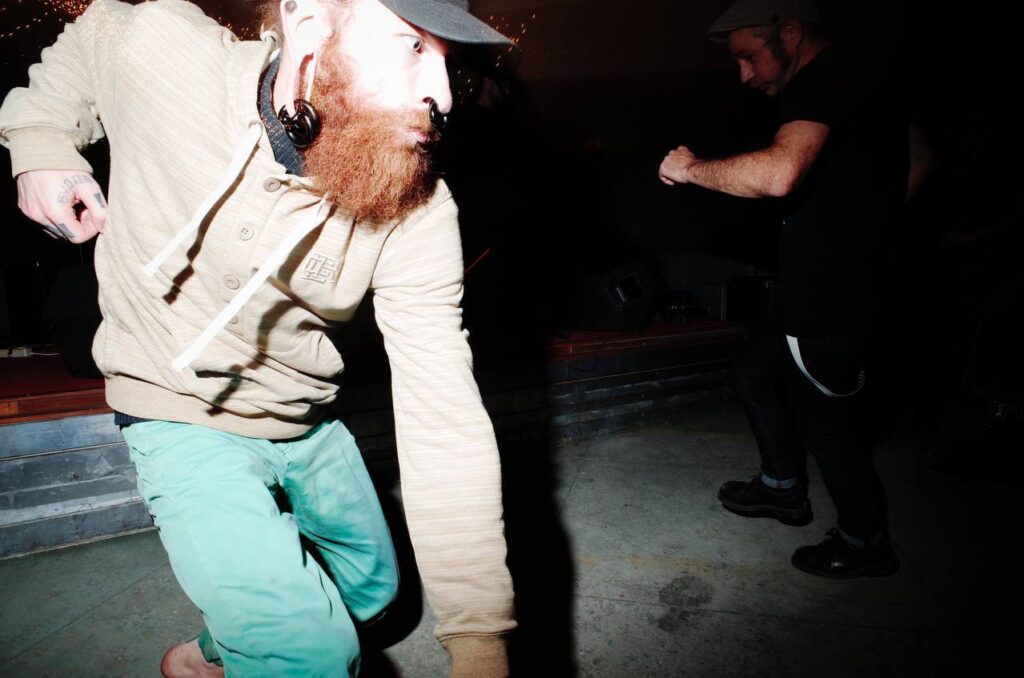
With the mass departures, the number of rock attendees has obviously decreased. Nevertheless, the halls are by no means empty. And for big bands like, for example, Galantereya, Challenger Deep, or Weed & Dolphins, you can see the club almost packed to capacity.
— For a scene to live, there must be recordings. Have any new recording spaces opened, and how accessible are they to musicians now?
— In 2024, there are plenty of opportunities for high-quality and inexpensive home recording of any instrument, excluding drum kits—and that’s what young musicians are using. Meanwhile, the number of professional recording studios has remained at roughly the same level.
— Why are guitar indie, shoegaze, and midwest emo gaining momentum in Minsk right now, in your opinion?
— Hardcore and punk have almost disappeared from the country’s musical map. Metal is crap. There is very little experimental electronics, and the mainstream stuff is of no interest. Therefore, for the erudite listener, indie and emo are what’s left.
— What is happening in other cities in Belarus? Which cities would you highlight in terms of the music scene?
— Independent concerts outside the capital have practically stopped. Only two places stand out with regular gigs—bar Five No in Grodno and Bar Kvartirnik in Gomel. Endless honor and praise to these places, since it is much harder to run all of this and maintain relevant interest and profitability in regional cities.
— Do you think that when the screws are tightened, music becomes angrier, or does it adapt to the forced situation?
— The situation is such that without adaptation, nothing will happen with the music, regardless of how angry you are or how angry the music you play is.

— How would you characterize this period of the scene in Belarus in two words?
— Total f***ed-up-ness.
— What 2024 projects would you highlight and recommend?
— If we limit ourselves to those bands and musicians who are still in the country, I can highlight a few groups close to my heart.
These are midwest emo bands Golos Medvedya, Svobodnoye Mesto, and The Mopses. The band Galantereya, which plays guitar indie-pop, the jazz-fusion collective Lakritsky i Apokalitichesky Orkestr, and the hardcore punk band Spiral Bruno.
If you want to look beyond my personal perception, there are plenty of thematic playlists on Spotify by Podpolny Vestnik dedicated to the local scene—everyone can find something suitable there. Additionally, once a month we host a stream called “Otdel Mestnoy Produktsii” (Local Product Department), where we review all the releases that came out during that period.