


Emigration
From Bosnia to Barcelona: A cross-border skateboard trip, freegan heating at gas stations, and a difficult recovery from Russia.
Andrey and Sasha are refugees from Russia, anti-authoritarian activists, and people for whom “home” is not about walls and furniture, but about the opportunity to sleep peacefully. They didn’t fly by plane, didn’t turn to agencies, and didn’t prepare documents with notarized translations. Their path involved a 15-kilometer night trek with an injured companion, cold, police vans, and a visa-free slip through the Schengen zone. But the main thing isn’t how they did it, but why.
In the second part of our interview, we talk about crossing the border with the adrenaline of shoplifting, living in a squat and growing dreams amidst recycling, spontaneous joy, and long-term decompression. And also about the underground heroes of a new anti-war era, the fear that needs to be left behind, and the hope that is worth carrying with you, even if it fits into just one bag.
Illegal FlixBus, False Starts in Croatia, and a Low-Cost Flight to Nowhere
NTD: How did you end up in Spain?
Andrey: We reached Bosnia by bus. At first, we thought we’d go all the way by hitchhiking. We really wanted to cross the border that way. But we changed our minds because there were too many risks. The main goal was to actually arrive, not just to travel. And we weren’t alone. We took a girl from the immigration camp with us. We’d talked with her a bit; she’s also a refugee from Russia. She was the only person we socialized with. Honestly, she didn’t share much, but she’s from Russia… usually, it’s obvious by default why a person leaves. Because a harsh dictatorship is setting in. The state starts dictating “recipes for happiness”—what kind of person you should be, what gender you should be, and so on. She was a trans woman, and simply for being a trans woman, she could have gone to prison. Naturally, she didn’t want that.
Anyway, we reached Bosnia and Herzegovina by hitchhiking. In Bosnia, we got to the city of Bihać. From there, we walked 15 kilometers to the land border with Croatia.
We set out in the evening, around 7 or 8 PM. We only arrived at one or two in the morning. Mainly because the girl with us had a leg problem and it was hard for her to walk. Her shoes chafed her so badly she almost couldn’t move. So, it took a very long time. It was a bit tough because of the duration.
At the border, they turned us back and told us to come back in the morning. We spent the whole night sleeping near a gas station because the station was closed. It was freezing. I even got sick—well, more than a little. I felt really bad. It was fucking cold, actually. We had to walk, run, or jump around just to keep from freezing. Luckily, a polite and kind security guard brought us a blanket that we took turns using to warm up.
In the morning we went to the border again—and again they turned us back. There were several attempts like that.
Then, after one of those attempts, we met a guy who approached us and said, “Oh, you’re Russian speakers, Russians, that’s cool, I also need to get the hell out of here.” He was a very shady type. But we actually got lucky meeting him because he didn’t know how to escape Russia or legalize himself anywhere, but he had money—which we didn’t have. We helped each other. He paid for a hotel room where we could finally sleep normally, warm up, and wash—we were incredibly happy. And then we even took a taxi, not walking those 15 kilometers, to get to the border.
After a few tries, they finally let us into Croatia.
They stuffed us into a police van; we traveled for 6 hours, just lying there waiting. The funniest thing was the ride itself because we weren’t buckled in; it was just a standard van with benches and that’s it.
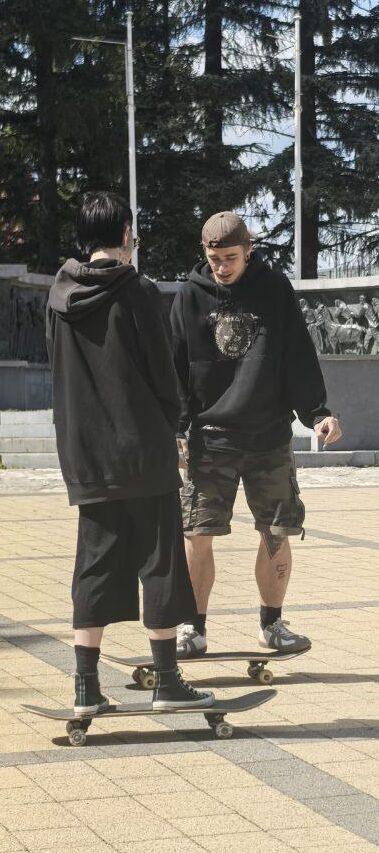
They drove very fast, and everyone went flying on the turns. I liked it, the others not so much. Sasha even hurt her leg a bit. Everyone got banged up a little. But for me, it was pure fun, like a roller coaster. I had my skateboard with me and was just cracking up. I had a blast.
Sasha: For all refugees requesting asylum right at the border (rather than in a city), they first seize your documents, phones, and money. Then they conduct a search, after which people are placed in a van for several hours until fingerprints are taken and a referral to a camp is issued.
NTD: What was the reason for the refusal? Why wouldn’t they let you in at first?
Andrey: Just because the border guards are assholes. Whether they let you in or not is at their personal discretion. They’ll mock you as much as they want. At that same border… well, from the stories I’ve heard, Sasha told me they raped an Afghan woman there. They forced some people to walk barefoot through a cold river, others were treated differently… they just torment people.
Also, the border guards really hate people from the Caucasus, Chechens for example. There are well-documented cases online of guards beating Chechens. That happened at this same border.
I don’t know if it was those specific guards, but we got lucky. There was no violence directed at us—at least compared to what used to happen there.
NTD: How did Spain come into the picture? You arrived in Croatia, and then what?
Andrey: We didn’t stay in Croatia for long. Just walked around, looked at things, and were shocked to see LGBT flags hanging in the center. It was wild. After all these conservative countries—Bosnia is a Muslim country, for example, where we spent a few days. It’s an interesting, cool country, but yeah, the cultural shock was real.
So, we took a bus from there to Hungary. Since there are essentially no Schengen borders between Croatia and Hungary, we just hopped on a FlixBus. They didn’t check our IDs, and we got incredibly lucky because we basically jumped into the last carriage. After us, they started stopping people and checking. We know stories of others who tried the same route and didn’t make it.
We arrived at the airport in Hungary, ran inside, and tried to avoid the police. We just sat quietly in the food court for about 12 hours waiting for our flight. We had online check-in, and our documents weren’t checked anywhere, so we basically slipped through unnoticed.
NTD: What did you feel when you crossed the border illegally?
Andrey: Adrenaline, like when you’re shoplifting. When you’re at the checkout and you have to pay for something, but you have, I don’t know, a bag full of energy drinks. You pretend to be like everyone else, but you know that if anything goes wrong, you’re screwed. It was the same: I didn’t sleep at all until we crossed the border. We were traveling at night. And when I saw that we passed the barrier, that everything was fine, no one stopped us, and the cops didn’t come in—I just exhaled and immediately passed out. I fell asleep.
NTD: What were your first thoughts and feelings when you arrived in Spain?
Andrey: That’s it. We achieved what we wanted. We dreamed of being here—and we made it. Just pure joy. We were so happy.
Sasha: For me—absolutely nothing.
It only sank in about a week later, maybe two. Because we had prepared for so long, especially with the visa—so much money and time went into it, and nothing worked out. But with Spain, it all happened so spontaneously that I don’t even know… It felt unreal, undeserved somehow, too easy.
It was only after a week or two, walking through the city, going into local shops, hearing people speak Spanish, that the positive feelings started to come. A sense of freedom, yes. Relief.
Squat Equals Home, Freedom as a Goal: Migration, Activism, and a New Reality
NTD: Now you are living in the “Los Almendros” squat. How did you end up here? How is life? What can you tell us about your daily routine?
Andrey: We ended up here through acquaintances. I was lucky to meet a great guy from Moscow who used to visit us in St. Petersburg and stay at our commune. I asked him about Spain then because I knew that sooner or later we’d end up here. He said he had a contact. When we arrived in Spain, I immediately wrote to him, of course. He put me in touch with a guy who helped us tremendously. He gave us contacts for where to stay the first night—right here in Barcelona. Later, I wrote to another friend who lives in Germany—he gave me the contact for a guy from a neighboring squat. And basically, that guy moved us in here.
NTD: How do you live? Food, work, insurance, documents?
Sasha: For now, it’s all shitty.
Everything is very complicated. A huge, terrifying bureaucratic machine. Until you register your application as an asylum seeker, you basically have nothing. And social organizations don’t help. You have to manage on your own somehow.
If you come here this way, you usually need some means of survival before your appointment—rented housing, food, and everything else. Or you have to rely on shelters.
NTD: Do you have any plans for the future? What would you like to do in Spain? Any ideas about starting your own commune or projects? Or do you just want to live and not worry—Spanish style?
Andrey: Yes, I really want to do the same thing I did in St. Petersburg. Body modifications: eyeball tattooing, elf ears, tongue splitting, things like that. Experimenting. Actually, I’d love to squat a house here and turn it into a place where I can do body mods and live at the same time. Though, generally, I’m okay with how things are now. I’m not a very demanding person. There’s “frigo” (dumpster diving), recycling, plenty of fruits and vegetables. The only thing I really need money for is tobacco, maybe, or treats like energy drinks that are hard to find in the trash.
Sasha: Heal the mental scars from Russia.
NTD: Do you feel at home now? Or is this just another pause?
Andrey: 100% yes. Because I’ve always dreamed—besides skating (I skate, I love skateboarding)—of getting a BMX and learning how to ride. In Russia, I could never afford it. Not just because of the price, but because I knew I was leaving. I didn’t have a permanent place to live. I just traveled between cities, stayed with people, lived on couches. But here, I realize I can have a permanent place to live near Barcelona. I’m even thinking of getting a BMX and learning to ride.
Sasha: I don’t have specific plans. Just a feeling of relief—not so much a connection to a place, but rather liberation. Knowing you can stop somewhere and relax. Not necessarily in a house, but just here and now, doing nothing, without fearing for your life or freedom.
“I’d Be More Scared to Stay”: Why Leaving Russia Isn’t Betrayal, But a Choice for Life
NTD: What would you like to say to people who are still afraid to leave Russia?
Andrey: Actually, I’d be more afraid of staying in Russia. Simply because I understand: in Russia, you wake up today and everything seems fine, but tomorrow you wake up to a knock on the door. And then come the unpleasant events.
I have so many friends in prison right now for such ridiculous reasons. Take the latest example—they tried to lock a guy up, but thank God it didn’t work. Semyon Olman. He just put a sticker in the subway. A sticker, damn it! An “Antifa Action” sticker. And that was it.
Antifascism is effectively banned in Russia. They call the “Special Military Operation” an “anti-fascist operation,” but the actual antifascists are treated like terrorists. The Russian state tells you directly: antifascism is terrorism.
Look at the group “Antisocial Distancing” from Kaluga—they were declared terrorists. Simply for their antifascist views and their songs.
So, as far as I’m concerned, if you want to live—you have to leave Russia. You don’t have to be a hero, you don’t have to perform a feat, but at least just choose life.
But if you’ve already stayed, if you have a different position—then maybe you’ll decide on something radical. Like Ruslan Siddiqui, the anarchist who recently blew up a train. I consider him a hero. I really want to write him a letter of support.
His story touched me to my core. He performed a real feat. I don’t know how to put it… it deserves respect. He blew up a train carrying supplies for the war. By doing that, he didn’t just cause economic damage—damage worth tens of millions, if not more—he slowed down the whole chain. Because the tracks were blown up, the following trains couldn’t pass on time either.
Perhaps that’s even more important than the fact of destroying one train. Because logistics are the lifeblood of any war.
In short, he’s a legend. A legend, no exaggeration.
Sasha: Maybe you shouldn’t wait for things to get “even worse,” and you shouldn’t hold on to material things—because in the face of repression and war, no apartment or possessions can protect you from fear, violence, or loss of freedom.
And it’s important to ask yourself first: “What am I afraid of? And what am I losing by staying?”
Many think: “It’s not that scary yet,” “It won’t affect me,”—but experience shows: when things get tight, it will be much harder to act.
No one has to cope alone. Start small—find those who have already left, write to migrant communities or human rights organizations. There is no shame in asking for help. It’s not weakness or selfishness, but basic self-care.